
NexusWard
Institutional memory that doesn't retire.
When the person who remembers retires, so does the memory
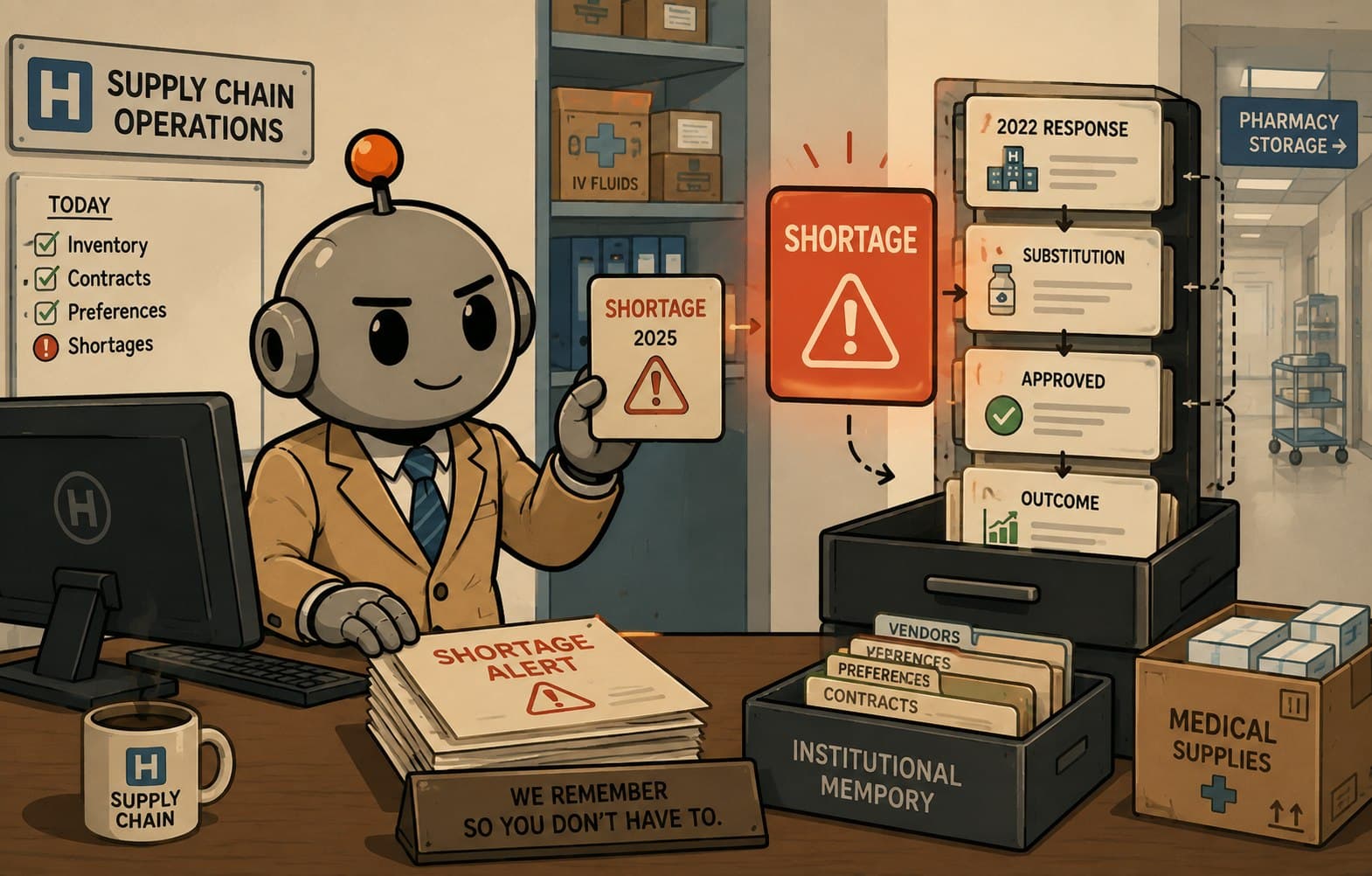
A hospital supply chain team runs on several computer systems that were never built to talk to each other: one for purchasing, a separate one for the operating room, a scatter of spreadsheets for whatever the official systems don't handle well. None of that stops the team from doing the job. What it stops is the job from being written down anywhere searchable. Which vendor actually comes through when a product is backordered. Why a surgeon insists on one supplier's clamps over another's. What the hospital did the last time a common IV fluid ran short, who signed off on the substitute, and why. That knowledge lives in one person's head, one inbox, one spreadsheet nobody else knows exists. When that person retires or moves on, it goes with them, and the next crisis gets solved from zero. It is not a small inefficiency. A 2025 survey of hospital pharmacy leaders found that managing drug shortages alone costs U.S. hospitals close to $900 million a year in staff labor, more than double what the same survey found in 2019, plus roughly $200 million a year in higher prices paid for substitutes when the preferred product isn't available. Shortages aren't rare: the average hospital tracked 43 active drug shortages over the course of 2023, and nearly six in ten that started in 2024 lasted two years or more. Every one of those crises produces a decision. Today, that decision usually lives in an email thread nobody can find six months later.
It reads what you already have, and writes down what it means
NexusWard quietly collects the documents and spreadsheets a supply chain team already produces, plus a handful of online sources, and connects them into a map of the vendors, contracts, shortages and decisions those documents describe. Ask it later: we're short on this item, what did we do last time, who approved it. It answers in plain language, pointing at the exact document behind every part of the answer. It reads from your existing purchasing and inventory systems. It never writes back into them. NexusWard keeps its own separate record, so it cannot enter, change or corrupt anything in the systems you already depend on to run.
Show the source, or it isn't an answer. That one rule is what makes this a fundamentally different product from a generic AI chatbot that sounds confident either way.
We're short on this item. What did we do last time, who approved the substitute, and why?
What it actually does
Gets the number straight first
Two systems that are both correct, say the pharmacy's count and the purchasing system's, can disagree about how much of an item is on hand, because they use different units, different names for the same product, or count vendor-owned stock differently. Reconciling that disagreement is the first thing NexusWard does. Everything else is built on top of it.
Connects the vendor, the contract and the decision
It builds a map that ties a shortage to the vendor involved, the contract terms, the substitution that got approved, and the person who approved it. Ask about any one of those and the others come with it.
Cites its source, every time
Every claim in an answer points back to the specific document it came from. In a regulated industry where 'the AI said so' does not hold up in front of a compliance officer, the citation is the product, not a feature bolted on afterward.
Reads your systems. Never writes to them.
NexusWard pulls information out of the systems a hospital already runs and keeps its own separate record. It cannot enter, change or corrupt your existing purchasing or inventory software, because it is never given permission to write back into it.
How it's built
What drug shortages already cost hospitals in labor
Plus an estimated $200M a year in premium pricing for substitutes (Vizient, June 2025). That is a market estimate, not a NexusWard projection. The United States has 6,093 hospitals, and hospitals spend an estimated $146.9B to $285B a year on medical and surgical supplies (American Hospital Association, 2026; Definitive Healthcare and Sales Data Generator, 2025), so this is one expensive symptom of a much larger, thin-margin problem.
VPs of Supply Chain and Materials Management, and the compliance officers and CFOs who have to trust an answer before it goes in front of an auditor
Your purchasing system knows what was ordered and for how much. Neither it nor your inventory system has a field for why. Why is the part that walks out the door when the person who knew it retires.
Request a Briefing
Start the conversation on the product's own site.

This product is built by
CHAOSAiGENT
A venture studio that builds tools, platforms, and products for operators who move fast.